The BC547 is a widely used NPN Bipolar Junction Transistor, especially popular in beginner-level electronics and engineering projects. It is ideal for switching applications and signal amplification, and due to its versatile characteristics, it’s often found in embeded systems and hobbyist circuits. Before diving into physical prototyping, it’s recommended to simulate the BC547 in Proteus or a similar simulation software. Simulation helps validate the circuit’s behavior and minimize hardware-level errors.
BC547 Pinout
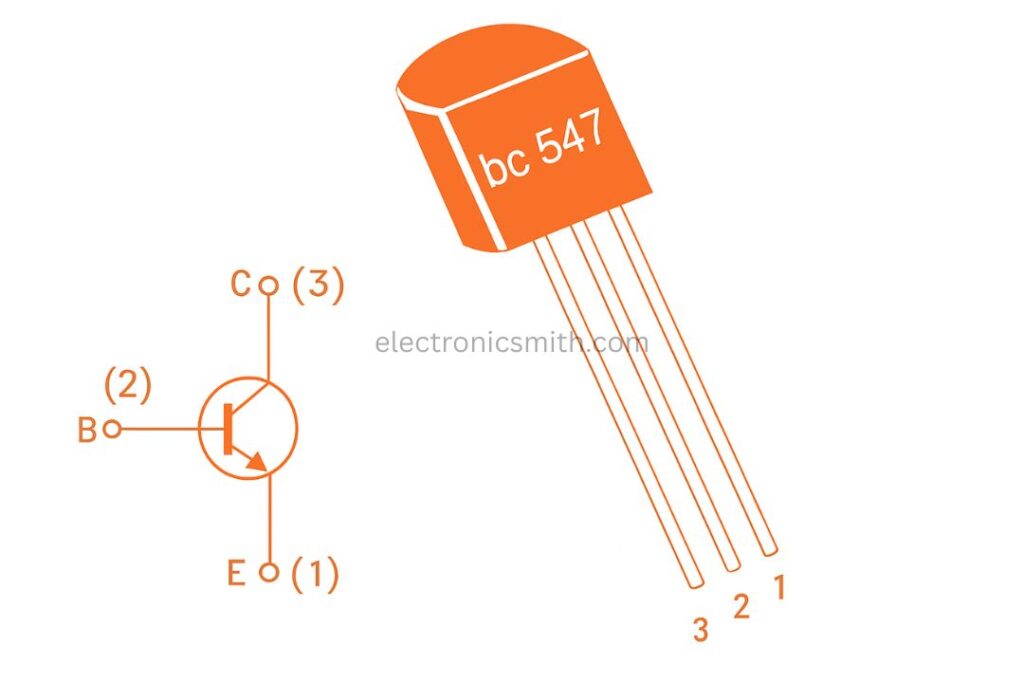
| Pin | Name | Function |
|---|---|---|
| 1 | Collector | Connects to the load (positive end) |
| 2 | Base | Controls the transistor (trigger input) |
| 3 | Emitter | Connects to ground or the negative terminal |
BC547 Transistor Overview
Type: Bipolar Junction Transistor (BJT)
Configuration: NPN
Common Uses: Switching, amplification, Pulse Width Modulation control
Package: TO-92
Electrical Characteristics of BC547
Understanding the key parameters of BC547 is essential for choosing it in the correct context.
- Collector-Emitter Voltage (V<sub>CE</sub>): 65V
- Collector-Base Voltage (V<sub>CB</sub>): 80V
- Emitter-Base Voltage (V<sub>EB</sub>): 8V
- Maximum Collector Current (I<sub>C</sub>): 100mA
- DC Current Gain (h<sub>FE</sub>): Up to 800
- Transition Frequency (f<sub>T</sub>): 150 MHz (typical)
- Package Power Dissipation: ~500 mW
Working Principle and Modes of Operation
The BC547 transistor operates based on how it is biased in the circuit, which determines whether it allows current to flow or not. It essentially acts as a switch or amplifier depending on the mode of operation.
Forward Active Mode
In this mode, the base-emitter junction is forward biased while the collector base junction is reverse biased. When a small current flows into the base terminal it allows a much larger current to pass from the collector to the emitter. This makes the transistor behave like an amplifier, where it can boost weak signals. It is the most commonly used mode in analog electronics.
Cut-Off / Reverse Bias Mode
When both the base-emitter and collector base junctions are reverse biased the transistor remains in the cut-off region. In this state no current flows from collector to emitter and the transistor effectively acts like an open switch. This mode is primarily used in digital logic and switching applications, where the transistor either allows or blocks current completely.
Applications of BC547
The BC547 is versatile and finds application in several scenarios:
Switching Circuits
Used to turn devices on and off, such as LEDs, motors, or small relays. When the base receives a sufficient current, it conducts and completes the circuit.
Signal Amplification
Amplifies weak analog signals in audio systems or sensor circuits, thanks to its high gain.
PWM Motor Control
Ideal for Pulse Width Modulation control in robotics and automation to regulate the speed of DC motors.
Conclusion
The BC547 transistor is a fundamental component in electronic design particularly for those getting started with digital electronics or embedded systems. Whether you’re working on signal amplification automation or simple switch based control, the BC547 provides a reliable and cost effective solution. To ensure optimal performance and avoid circuit failure always check the datasheet and simulate your design before implementing it physically.